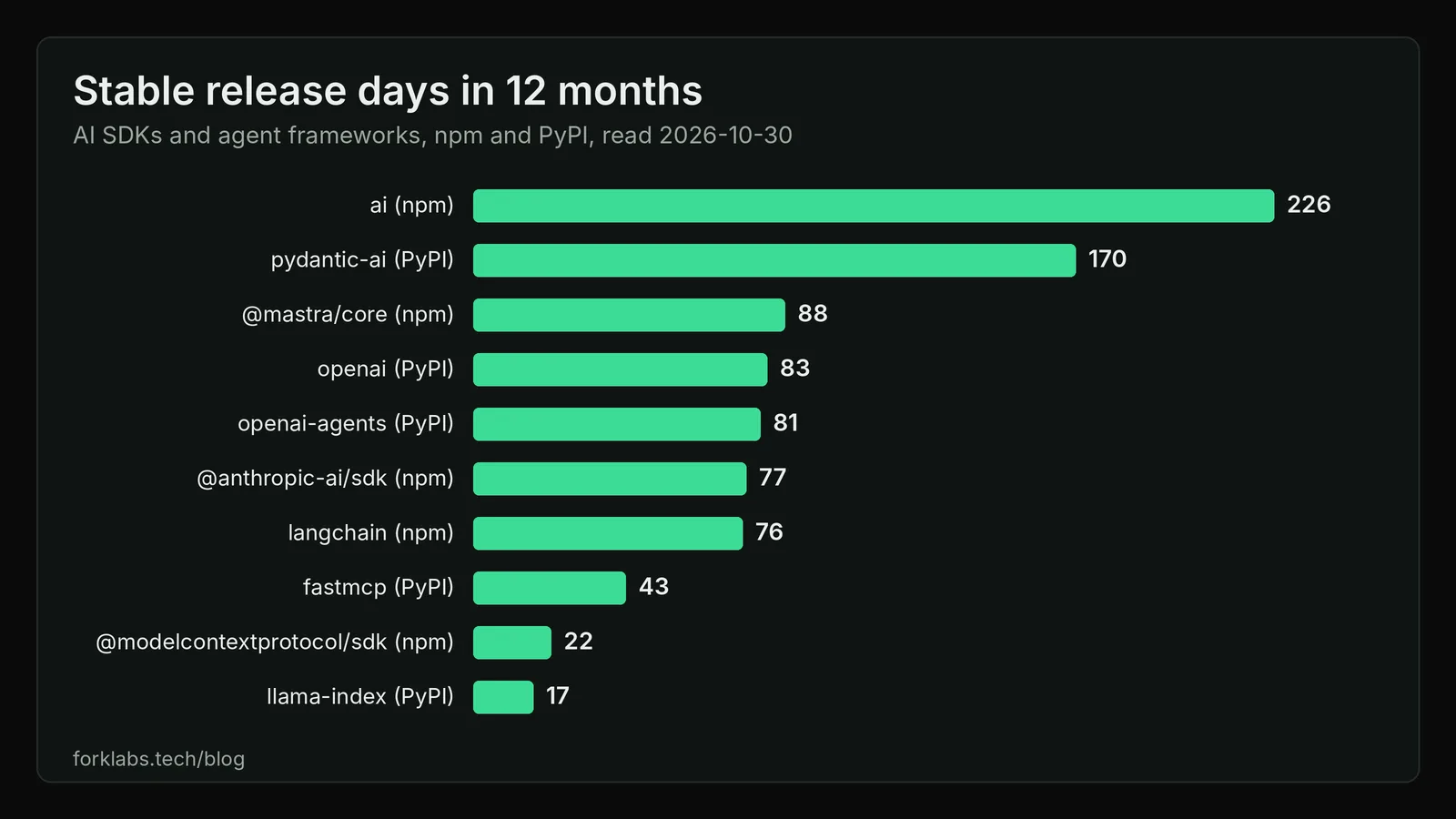
If you build agents or LLM features, your dependency list moves faster than almost anything else in your stack. We wanted numbers instead of impressions, so we counted every stable release of 22 popular LLM SDKs, agent frameworks and MCP libraries over the last 12 months. The raw table is available as a CSV.
All data was read on October 30, 2026, directly from the npm and PyPI registries. Nothing comes from memory or from a third-party aggregator.
Method
We read publish timestamps from the public package registries:
- npm packages: the
timefield of each registry entry, for example registry.npmjs.org/@modelcontextprotocol/sdk. Versions that no longer exist in the entry were dropped. - PyPI packages: the JSON API, for example pypi.org/pypi/mcp/json, taking the earliest upload time of each version and ignoring yanked files.
The 12-month window is 2025-10-30 up to, but not including, 2026-10-30 (UTC). The 90-day window starts 2026-08-01. A stable version is one made only of dot-separated numbers, so alphas, betas, release candidates, dev builds and canary tags are excluded. A release day is a UTC calendar date on which at least one stable version was published. We count both, because one day can carry several versions, for example patches to more than one major line.
median_gap = median( date[i+1] - date[i] ) over sorted distinct release days in the window
We computed every figure twice, once in a Python script and once with SQL over the same raw timestamps, and the results matched for all 22 packages. We also re-fetched the data after noticing that unpublished npm versions still appear in the time field. Filtering those out changed one number (@mastra/core, 103 to 102 versions).
Model provider SDKs
Each of the three big providers ships a Python and a Node package, so we can compare them.
| Package | Stable versions, 12 months | Release days, 12 months | Release days, 90 days | Median gap (days) | Latest stable (date) |
|---|---|---|---|---|---|
openai (PyPI) |
105 | 83 | 39 | 3 | 3.41.0 (2026-10-28) |
openai (npm) |
89 | 68 | 27 | 4 | 7.45.1 (2026-10-27) |
anthropic (PyPI) |
91 | 76 | 22 | 3 | 2.3.0 (2026-10-23) |
@anthropic-ai/sdk (npm) |
92 | 77 | 21 | 3 | 1.3.0 (2026-10-23) |
google-genai (PyPI) |
69 | 64 | 18 | 6 | 2.34.0 (2026-10-29) |
@google/genai (npm) |
62 | 59 | 17 | 6 | 2.32.0 (2026-10-29) |
Sources: pypi.org/pypi/openai, registry.npmjs.org/openai, pypi.org/pypi/anthropic, registry.npmjs.org/@anthropic-ai/sdk, pypi.org/pypi/google-genai, registry.npmjs.org/@google/genai. Read 2026-10-30.
Median gaps between release days are 3 to 6 days for all six. The OpenAI Python package is the busiest of the group with 83 release days, and the Google packages are the slowest at 59 to 64. Version numbers are not comparable across ecosystems: the major versions differ between a vendor's Python and Node packages (for example anthropic on PyPI is at 2.3.0 while @anthropic-ai/sdk on npm is at 1.3.0), so never read a version number as a measure of maturity.
Agent frameworks and MCP libraries
| Package | Stable versions, 12 months | Release days, 12 months | Release days, 90 days | Median gap (days) | Latest stable (date) |
|---|---|---|---|---|---|
ai (npm) |
656 | 226 | 64 | 1 | 7.0.157 (2026-10-29) |
pydantic-ai (PyPI) |
190 | 170 | 46 | 1 | 2.63.0 (2026-10-28) |
@mastra/core (npm) |
102 | 88 | 22 | 4 | 1.80.0 (2026-10-28) |
openai-agents (PyPI) |
85 | 81 | 12 | 3 | 0.24.0 (2026-10-15) |
@openai/agents (npm) |
76 | 70 | 11 | 3 | 0.21.0 (2026-10-20) |
langchain (PyPI) |
56 | 50 | 12 | 5 | 1.4.7 (2026-10-21) |
langchain (npm) |
85 | 76 | 15 | 4 | 1.6.0 (2026-10-28) |
@langchain/langgraph (npm) |
60 | 53 | 16 | 5 | 1.5.3 (2026-10-26) |
langgraph (PyPI) |
36 | 35 | 8 | 8.5 | 1.2.18 (2026-10-26) |
crewai (PyPI) |
63 | 57 | 19 | 5.5 | 1.15.33 (2026-10-28) |
fastmcp (PyPI) |
52 | 43 | 16 | 6 | 4.1.4 (2026-10-26) |
@modelcontextprotocol/sdk (npm) |
25 | 22 | 5 | 8 | 1.32.2 (2026-10-23) |
mcp (PyPI) |
26 | 22 | 5 | 10 | 2.3.0 (2026-10-02) |
llama-index (PyPI) |
17 | 17 | 2 | 20 | 0.14.25 (2026-09-21) |
llamaindex (npm) |
1 | 1 | 0 | n/a | 0.12.1 (2025-12-02) |
autogen-agentchat (PyPI) |
0 | 0 | 0 | n/a | 0.7.5 (2025-09-30) |
Sources: the registry entry for each package, linked per row in the CSV. Read 2026-10-30.
A few things stand out:
- The
aipackage on npm published 656 stable versions in 12 months across 226 release days. In the last 90 days its stable versions fall on three major lines (7, 6 and 5), so part of that volume is backports. That is why release days are a fairer measure than versions. pydantic-aishipped on 170 distinct days, a median gap of 1 day.- The MCP libraries are calmer. The official TypeScript SDK (
@modelcontextprotocol/sdk) and Python SDK (mcp) each had 22 release days, with median gaps of 8 and 10 days. The communityfastmcppackage had 43. llama-indexon PyPI had 17 release days. The npmllamaindexpackage had one in the window (2025-12-02), andautogen-agentchathad none; its latest stable is 0.7.5 from 2025-09-30. We did not check why, so we only report the dates.
What the numbers mean for a decision
Pin and batch rather than float. With model SDKs releasing every three to six days at the median, an automated bot that opens a pull request per release will flood a team. A weekly grouped update is usually enough. Example arithmetic, not a measurement of your repo: a Python agent that depends on openai, anthropic, langchain, langgraph and mcp could see up to 39 + 22 + 12 + 8 + 5 = 86 triggering release days in 90 days, so up to about one per day if none overlap.
Match review effort to cadence. A package that ships almost daily can be bumped by tests alone. A package that ships every 10 or 20 days, such as mcp or llama-index, may bundle more changes per release, so read the changelog. This is a rule of thumb, since we did not measure release size.
Expect two rhythms if you span languages. langchain and langgraph appear on both registries and their gaps differ (langgraph is 8.5 days on PyPI and 5 on npm for the JS package). A team on Python and Node maintains two upgrade cadences.
Watch the last-release date. Two packages in the table have no stable release in the last three months. Before you adopt a library, check the "latest stable" date, not only its stars.
Our approach would be to isolate the model SDK behind a thin internal interface, so the fastest-moving dependency touches the least code, and keep the rest on a slower cycle.
Caveats
- A release is not an upgrade you must take. Many are small patches, and we did not measure size or breaking changes.
- Registry timestamps are when a version was uploaded, not when it was announced.
- Popularity was our selection criterion, not a ranking; we picked well-known packages and did not claim a complete census. Other frameworks are missing.
- Backports inflate version counts. Release days reduce but do not remove that effect.
- Names collide across registries (
openai,langchain), so each row names its registry.
Cite and reuse
You are welcome to reuse the table and CSV with a link back. Suggested citation:
Fork Labs, "How often AI SDKs and agent frameworks ship, October 2026 data", forklabs.tech/blog/agent-and-llm-sdk-release-cadence-october-2026, October 30, 2026.
If you spot an error or want a package added to the next edition, tell us and we will correct the post and the CSV.