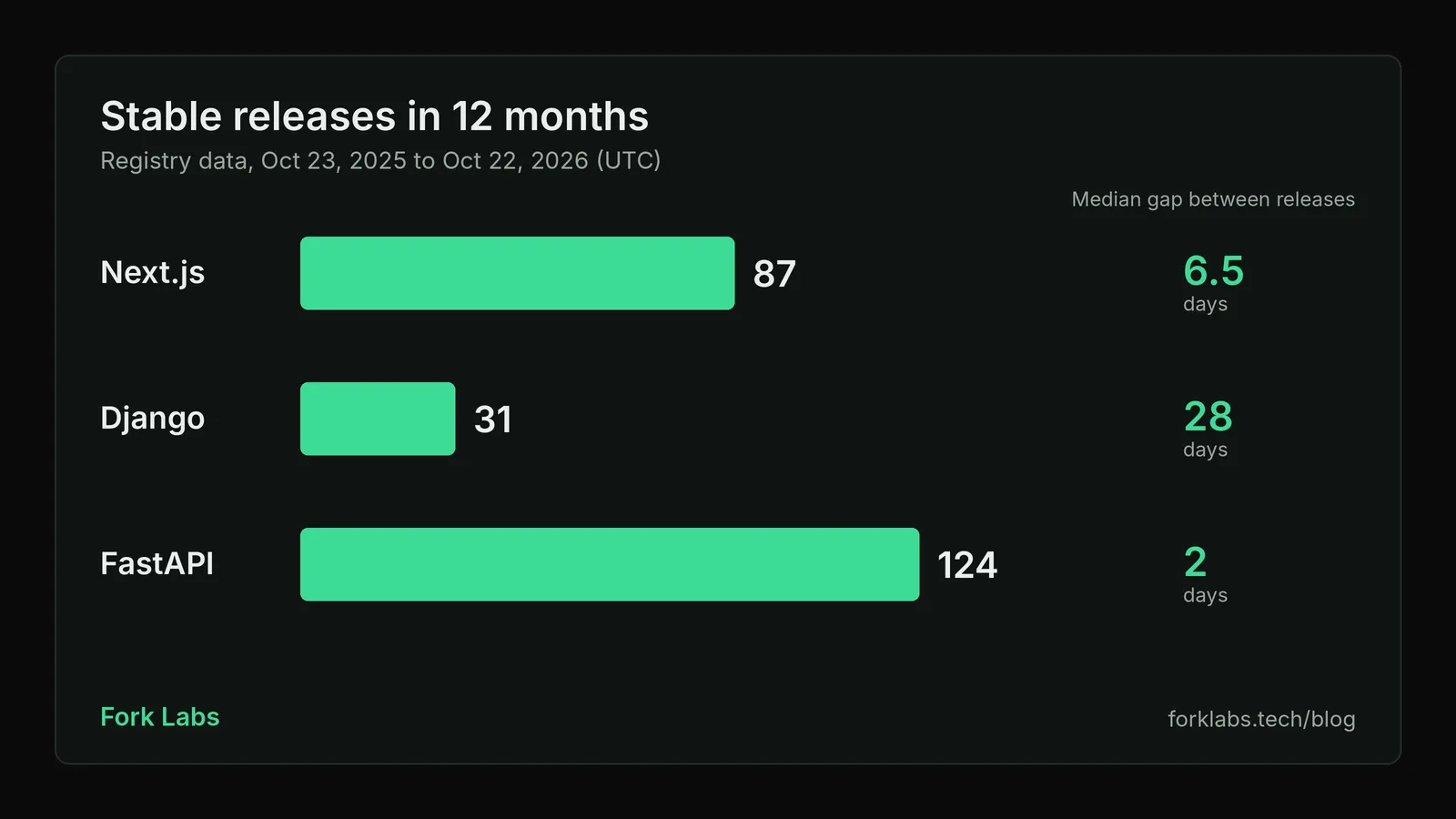
Teams budget upgrade work without knowing how often the upgrades arrive. "Django is slow and boring, FastAPI moves fast" is folk wisdom; we wanted numbers. This post counts every stable release of Next.js, Django and FastAPI over the 12 months to October 23, 2026, and turns them into a few figures you can plan around. The raw list of 242 releases is available as a CSV.
All data was read on October 23, 2026. Nothing here comes from memory or from a third-party aggregator.
Method
We read publish timestamps directly from the public package registries:
- Next.js: the
timefield of the npm registry entry fornext. - Django: the JSON API at pypi.org/pypi/Django/json, taking the earliest upload time of each version.
- FastAPI: the JSON API at pypi.org/pypi/fastapi/json, same rule.
The window is 2025-10-23 00:00 UTC up to (not including) 2026-10-23 00:00 UTC. A "stable release" is a version made only of dot-separated numbers, so release candidates, betas and canaries are excluded. A "release day" is a UTC calendar date on which at least one stable version was published; we count days as well as versions because one day can carry several versions (backports to older lines, for example). "Median gap" is the median number of days between consecutive release days.
median_gap = median( date[i+1] - date[i] ) over sorted distinct release days
We recomputed every figure in the tables a second time with separate code reading the exported CSV, and the results matched.
The numbers
| Project | Stable versions | Release days | Median gap (days) | Longest gap (days) | Latest stable in window |
|---|---|---|---|---|---|
| Next.js | 87 | 45 | 6.5 | 40 | 16.4.2 (Oct 15, 2026) |
| Django | 31 | 14 | 28 | 35 | Oct 6, 2026 (6.1.2, 6.0.9, 5.2.18) |
| FastAPI | 124 | 67 | 2 | 62 | 0.161.1 (Oct 22, 2026) |
New feature lines (a new minor or major version) in the same window:
| Project | New lines | Which |
|---|---|---|
| Next.js | 4 | 16.1 (Dec 18), 16.2 (Mar 18), 16.3 (Aug 3), 16.4 (Oct 6) |
| Django | 2 | 6.0 (Dec 3, 2025), 6.1 (Aug 5, 2026) |
| FastAPI | 42 | 0.120 through 0.161 |
Next.js 16.0 shipped on October 22, 2025, one day before the window opens, so it is not counted. The gaps between Next.js 16 minors were 57, 90, 138 and 64 days.
Next.js also published 489 non-stable versions on npm in the window, 479 of them canaries. If you track next@canary you see a new build almost daily; if you track latest you see the 87 above.
Releases per month, stable versions (October 2025 counts from the 23rd, October 2026 through the 22nd):
| Month | Next.js | Django | FastAPI |
|---|---|---|---|
| Oct 2025 | 1 | 0 | 5 |
| Nov 2025 | 5 | 3 | 7 |
| Dec 2025 | 26 | 4 | 20 |
| Jan 2026 | 13 | 2 | 0 |
| Feb 2026 | 1 | 3 | 18 |
| Mar 2026 | 5 | 3 | 3 |
| Apr 2026 | 4 | 3 | 4 |
| May 2026 | 4 | 2 | 1 |
| Jun 2026 | 4 | 2 | 6 |
| Jul 2026 | 6 | 2 | 19 |
| Aug 2026 | 8 | 3 | 0 |
| Sep 2026 | 6 | 1 | 3 |
| Oct 2026 | 4 | 3 | 38 |
What the numbers say
Django is a calendar. Its release days fall around the first week of each month: November 5, December 2, January 6, February 3, March 3, April 7, May 5, June 3, July 7, August 4, September 2 and October 6. Most of those days publish patch versions for two or three supported lines at once. The registry does not say which releases were security fixes, so we make no claim about that here; check Django's release notes for what each one contained. For planning, a monthly slot to bump the patch version is enough to stay current.
Next.js is bursty. Median 6.5 days between release days sounds frequent, but the monthly table shows why: 39 of the 87 versions landed in December 2025 and January 2026. December alone had 26 stable versions across nine release lines (14.2, 15.0 to 15.5, 16.0 and 16.1) on five release days, which is what backporting looks like in a registry. The practical lesson is that when a fix is backported, you may need to move quickly on whichever line you run. Having a tested upgrade path for patch versions matters more than having a calendar. Our earlier post on upgrading to Next.js 16.4 without breaking production covers the minor-version side.
FastAPI is a fast-moving 0.x. 42 minor versions in a year, and 124 stable versions overall, with a 62-day quiet stretch between July 29 and September 29, 2026 followed by 38 versions in October. Averages hide this: the median gap is 2 days, the longest is 62. Under the semantic versioning rules a 0.y.z version carries no stability guarantee, so a loose pin such as fastapi>=0.100 is a risk in production. We did not verify FastAPI's own compatibility policy for this report; read its release notes before choosing a pin.
Turning cadence into an upgrade budget
A rough rule we use when scoping maintenance retainers, from this data and our judgment, not a measurement:
- Django: one planned patch upgrade per month, a few hours with good tests, plus a deliberate move to each new feature line.
- Next.js: patch upgrades as needed and a minor upgrade every two to five months, based on the 57 to 138 day gaps above.
- FastAPI: pin the exact version in a lock file, upgrade on a schedule you choose (every two weeks or monthly), and run your test suite against the new version in CI before merging.
For FastAPI and Django services we build, a lockfile plus a scheduled dependency-update job is the baseline, because the cadence above is too fast to track by hand.
Caveats
- Registry timestamps show when a version was published to npm or PyPI, which can differ from the announcement date.
- Counting versions rewards projects that ship many small patches. That is why we also report release days and median gaps.
- Backports inflate Next.js and Django counts, because one fix can produce a version on each supported line.
- We did not classify releases as security, bug fix or feature. Treat the counts as activity, not risk.
- Django and Next.js support windows, and any security advisory data, are not part of this report. We could not verify them from a primary source during this run, so we left them out rather than guess.
- The window is one year. A different year could look different, particularly for FastAPI's bursts.
Cite and reuse
The CSV is free to reuse with attribution. Suggested citation:
Singh, S. "How often Next.js, Django and FastAPI ship, October 2026 data." Fork Labs, October 23, 2026. https://forklabs.tech/blog/framework-release-cadence-nextjs-django-fastapi-october-2026
If you find an error, or you have a project you would like included in the next edition, tell us through the "Start a project" button on this site and we will correct the post and CSV.